Fun Race 3D — Run and Parkour
- 4.3
- Rating
- 100.00M
- Installs
- Free
- Price
 Analysis by App-foxy
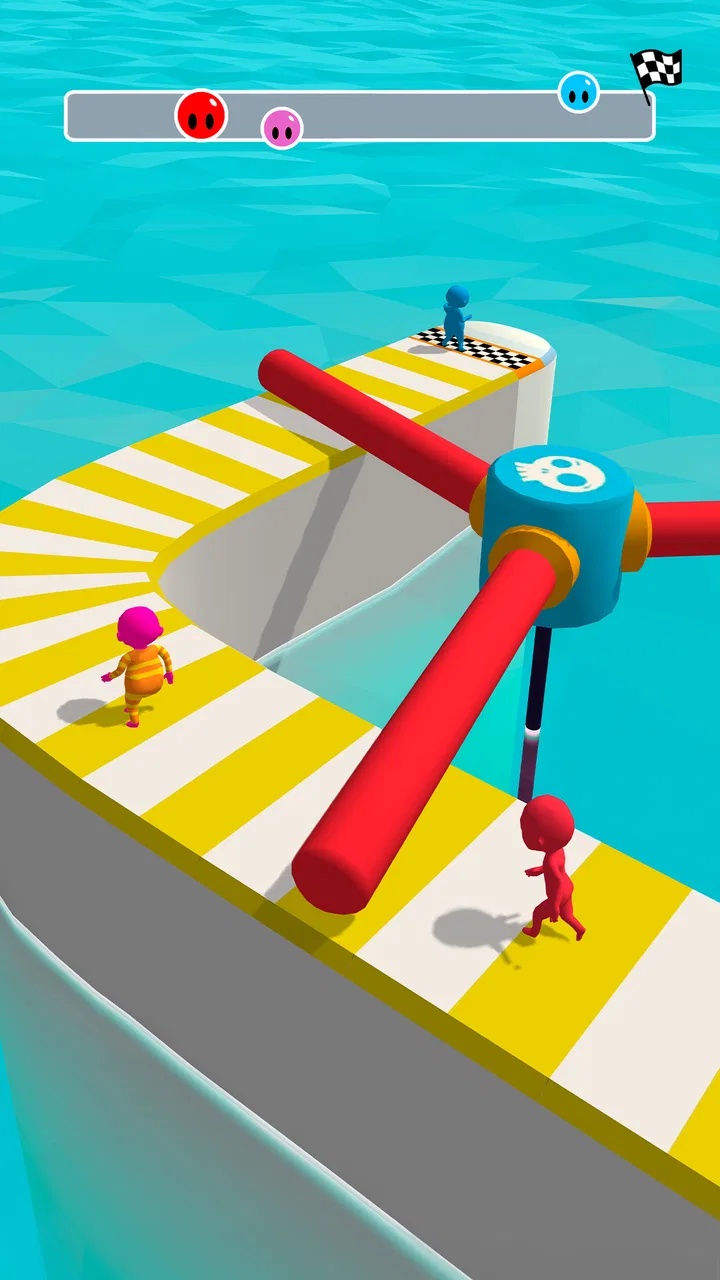
Fun Race 3D is the kind of racing game I open when I have a few spare minutes and want something immediately understandable. I guide a small runner through obstacle courses, time jumps and movements, and try to reach the finish before the other competitors. There is no complicated setup to learn, so the appeal is clear from the first attempt: tap, react, recover from mistakes, and try again.
My overall view is positive but specific. This is not a deep racing simulator or a serious parkour adventure. It is a quick, arcade-style challenge built around short bursts of timing. When I want a light distraction, that simplicity works very well. When I want detailed vehicle handling, long-term strategy, or a richer story, I would choose something else.
How the obstacle-course racing works in practice
The central idea is wonderfully easy to grasp. The character runs through a course filled with barriers and moving hazards, while I control the important moments rather than every step. A tap can make the runner jump, and the challenge comes from deciding when to act instead of simply tapping as quickly as possible.
You May Also Like

 AccuWeather: Weather Radar
AccuWeather Review: A Quick, Clear Forecast for Everyday Decisions
For everyday plans, the best forecast is the one you can understand quickly. AccuWeather makes rain timing, radar, and local conditions easy to act on, with a few trade-offs.

 Hill Climb Racing
Why Hill Climb Racing Still Turns Crashes Into One More Run
A tiny car, a bumpy hill and one more upgrade: Hill Climb Racing keeps resurfacing because its simple chaos makes every near-miss feel personal.

 AliExpress - Shopping App
AliExpress Makes Global Shopping Feel Personal, but Shoppers Bear the Risk
AliExpress turns a global marketplace into a pocket-sized discovery engine. Its reach is useful, its shopping loop compelling, and its trade-offs easy to miss.

 Lords Mobile: Kingdom Wars
Lords Mobile Is a Kingdom-Building Routine, Not a Quick Match
A case-by-case verdict on the building, battles, device demands, and social commitments that make Lords Mobile rewarding for some players and exhausting for others.

 PDF Scanner app - TapScanner
TapScanner Makes Paperwork Easier to Capture, Check, and Share
TapScanner makes scanning with a phone feel less like a rescue operation and more like a dependable step in getting work done. Its capture tools are useful, though not flawless.

 Block Blast!
 Shows How Much a Puzzle Game Can Leave Out
A quiet grid game shows why puzzle players increasingly value instant clarity, repeatable skill and low-pressure play—and where the genre still needs to catch up.
More From Our News Desk
View All News


That distinction matters. At first, I treated the game like a reflex test and reacted only when an obstacle was already close. I made unnecessary mistakes that way. A better approach is to watch the rhythm of the course, notice how long the runner remains airborne, and prepare for the next landing before the current jump is finished. The game becomes more satisfying once I stop thinking about individual obstacles and start reading the whole sequence.
The racing format also gives each attempt a small sense of urgency. I am not just trying to survive; I am trying to arrive ahead of the other runners. That makes a clean run feel more rewarding than simply reaching the end. A mistake can cost momentum, and recovering quickly is often more useful than panicking and tapping repeatedly.
I found the controls most comfortable when I used deliberate taps rather than constant input. That sounds obvious, but it is one of the most useful practical lessons here. Holding attention on the runner’s position, rather than staring only at the next barrier, helps me judge whether a jump will land safely. Players who prefer calm, predictable control may appreciate this approach more than people who expect a fully automatic casual game.
Why the short format works so well
The biggest strength is how neatly the game fits into everyday gaps. I can play while waiting for a coffee, during a short break, or when I have only enough time for a few attempts. There is no need to remember a complicated plot or rebuild a detailed setup after putting it down. I simply return to the course and focus on the next obstacle.
That makes it particularly suitable for people who enjoy mobile games in small sessions. It is also friendly to players who do not usually play racing games, because success depends more on timing than on learning a large control scheme. Someone who finds traditional racing games too busy may find this much easier to approach.
At the same time, the short-session design creates a trade-off. The game can be exciting in repeated bursts, but it may not hold the attention of someone looking for a substantial campaign. I enjoyed the immediate challenge, yet I would not install it expecting the variety or progression depth of a larger racing title.
Small techniques that improve consistency
One useful habit is to avoid tapping as soon as an obstacle appears on screen. I try to estimate the runner’s current pace and wait for the correct takeoff point. Early inputs can make a jump awkward, while a slightly later action may line up better with the landing area. The right timing is often less dramatic than I first expected.
Another helpful technique is to treat failed attempts as information. If I miss the same barrier twice, I do not simply repeat the exact movement faster. I watch whether the problem came from jumping too early, landing too close to the next hazard, or losing focus after a successful section. This turns the restart loop into a small learning process rather than a string of random retries.
I also recommend keeping the sound and visual pace in mind without relying on them completely. Visual cues are the main guide, but players can become overconfident when a sequence feels familiar. Looking ahead after each landing reduces the chance of celebrating one successful jump and immediately failing on the next one.
These details are not complicated advanced systems, but they make a noticeable difference. The game rewards attention to rhythm, spacing, and recovery. That is where much of its real value lies beyond the simple store description.
Where the experience is strongest—and where it loses momentum
My favorite part is the clean relationship between action and result. When I miss a jump, I usually understand why. When I complete a difficult section, the success feels connected to my timing rather than to a complicated upgrade system or a lucky outcome. That clarity makes the game easy to recommend for quick, skill-based entertainment.
The obstacle courses also provide a nice change from conventional mobile racing. Instead of steering a car around a track, I am managing a runner’s movement through a compact sequence of hazards. This gives the game a more playful feel than traditional racing apps. It is closer to an arcade obstacle challenge with racing pressure than to a driving game.
There is a useful middle ground here. The controls are simple enough for a newcomer, but the timing is not completely automatic. I can improve through practice, especially when I learn to anticipate rather than react. That balance is likely a major reason the game has reached over one hundred million installs and holds an average rating of 4.3 from around 2.6 million ratings.
Those figures suggest a broad audience, but they do not remove the personal limitations I noticed. The same loop that makes the game accessible can also become repetitive. If I play for too long in one sitting, the basic pattern starts to feel less fresh. I get more enjoyment by treating it as a short-session game instead of trying to make it fill an entire evening.
The main weakness: repetition and limited depth
The most important drawback is that the core idea does not expand into a deeply layered racing experience. The fun comes from timing jumps and overcoming courses, but players who need extensive customization, complex tracks, or a strong narrative may quickly want more. The game’s simplicity is both its identity and its ceiling.
I also think the competitive feeling is lighter than it may first appear. Racing against other runners adds pressure, but the real test for me remains navigating the obstacles cleanly. Anyone expecting the strategic overtaking, vehicle tuning, or route planning found in a conventional racing game may feel that this is a different genre wearing a racing label.
There is also the usual friction associated with a free mobile game. The game costs nothing to start, while optional in-app purchases are listed at $3.99 per item. I would approach those purchases carefully. They may suit someone who wants to support the game or obtain an optional convenience, but the basic appeal should be judged on the free experience rather than on the expectation that spending will transform the gameplay.
For younger players, the content rating is Teen, so I would not choose it automatically for a child just because the controls look simple. Parents should check the game’s suitability on the device and consider whether optional purchases need to be restricted. That is a practical step worth taking with any free game that offers in-app items.
Performance, access, and what to expect before installing
The game was released on May 28, 2019, and the current version is 2.0.44.8. It supports devices running Android 7.0 or later. That makes the compatibility requirement reasonably approachable for many Android users, although the experience can still vary depending on the phone’s age and general performance.
I would install it with realistic expectations. This is a game for immediate play, not a large download experience that I would choose for a long, immersive session. Before starting, I would make sure the phone has enough free space and that notifications are not likely to interrupt a difficult run. Small distractions matter when the entire challenge depends on a well-timed tap.
The developer is CASUAL AZUR GAMES, and the game has accumulated around 31 thousand written reviews. I see that as evidence of a substantial player conversation, but I would still judge it according to my own preferred session length. A popular casual game can be a great fit for quick play without being the best choice for someone who wants a more demanding long-term hobby.
Who should play it—and who should skip it
I would recommend Fun Race 3D to players who enjoy fast restarts, simple controls, and obstacle timing. It is especially suitable for someone who wants a game that can be understood without a tutorial-heavy introduction. If you like improving a run by adjusting one small decision at a time, the format has enough immediate feedback to stay engaging.
It also works well for families or friends who want to pass a phone around and compare how far they can get, provided the Teen rating fits everyone using it. The controls are easy to explain, so a new player can begin quickly. The more experienced player still has an advantage through better timing, which gives informal challenges some value.
I would skip it if your idea of racing means realistic cars, detailed tracks, tuning, or a persistent championship. A traditional racing game will be a better match for those needs. I would also look elsewhere if you dislike repeating short sections after mistakes. This game asks you to accept the restart cycle as part of the fun.
Players who need a strong story should probably choose a narrative game instead. There is no reason to approach this as an adventure with extensive character development. Its appeal is immediate control and obstacle mastery, and expecting something broader would make the experience seem thinner than it intends to be.
A realistic everyday session
Imagine having ten minutes before an appointment. I would open the game, complete a few obstacle runs, and use the first failures to identify the timing that was causing trouble. If I reached a section that felt difficult, I could make a couple of focused attempts rather than committing to a long campaign. When it was time to leave, I could stop without worrying about losing a complicated story thread.
That scenario captures the game’s best use. It does not demand a large block of free time, and its controls are easy to pick up after a break. The downside is that a short session can turn into many more attempts than planned because the next successful run always feels close. I would set a personal stopping point if I knew I was only taking a brief break.
How it compares with other mobile racing choices
Compared with driving-focused racing games, this one is much less concerned with speed management, steering precision, and vehicle behavior. That makes it easier to start but less satisfying for players who enjoy the technical side of racing. I would choose Fun Race 3D for a quick reflex challenge and a car racer for longer sessions built around track mastery.
Compared with endless runners, it feels more structured because the obstacle course gives each attempt a clear route and finish. Endless runners are often about surviving as long as possible while reacting continuously. Here, I am working through a defined sequence and trying to beat the other runners. That difference gives each level a stronger sense of a small contest.
Compared with more elaborate parkour games, it is intentionally lighter. There are fewer reasons to explore movement deeply, but that also means I can understand the basic objective immediately. The choice depends on whether I value quick accessibility or a broader movement system with more room to experiment.
For me, the best comparison is not a full racing simulator but a compact arcade challenge. Once I view it that way, the design makes more sense. I stop asking it to provide features it was never built around and can appreciate the precision of its short, repeatable format.
My verdict after spending time with the runner
Fun Race 3D succeeds because it keeps its central promise focused: move through an obstacle course, make better timing decisions, and try to finish ahead. The controls are approachable, the sessions are easy to fit into a busy day, and the restart loop can be surprisingly motivating when I am close to improving a run.
Its limitations are equally clear. Repetition can set in, the racing is not comparable to a full driving game, and the free-to-play structure deserves sensible attention around optional purchases. The Teen rating is another reason to check that it suits the intended player rather than assuming every casual-looking game is appropriate for all ages.
The current version is 2.0.44.8, the game is free to start, and Android users need version 7.0 or later. With over one hundred million installs, it is clearly an established choice in casual mobile gaming, but popularity should not obscure the important question: do you enjoy short, timing-based obstacle runs?
My recommendation is straightforward: install it if you want a quick arcade game that rewards patience, anticipation, and repeated practice. Use it in short sessions, treat mistakes as timing clues, and be cautious with optional purchases. Skip it if you are searching for realistic racing, deep progression, or a story-driven parkour experience. For the right player, it is an easy game to pick up and a surprisingly difficult one to put down.
FAQs for Fun Race 3D — Run and Parkour
01What is the main objective of Fun Race 3D?
Fun Race 3D is a thrilling parkour-style game where the main objective is to race against other players while overcoming various obstacles. Players must navigate through challenging courses, using speed and agility to avoid pitfalls and reach the finish line first. The game combines elements of racing and platforming for an engaging experience.
02Is Fun Race 3D suitable for all ages?
Yes, Fun Race 3D is designed to be family-friendly and is suitable for players of all ages. Its colorful graphics and simple controls make it accessible to younger players, while the competitive nature of the game can also appeal to older audiences. Parents can feel comfortable allowing their children to enjoy this game.
03Does Fun Race 3D require an internet connection to play?
Fun Race 3D can be played both online and offline. While an internet connection is required for multiplayer races and certain features, players can still enjoy races and challenges offline. This flexibility ensures that players can enjoy the game anywhere, without needing to worry about internet availability.
04Are there in-app purchases in Fun Race 3D?
Yes, Fun Race 3D includes in-app purchases that allow players to buy in-game currency, which can be used to unlock new characters, skins, and other enhancements. While these purchases can enhance gameplay, they are optional and not necessary to progress through the game. Players can still enjoy all core features without spending money.
05How do the controls work in Fun Race 3D?
The controls in Fun Race 3D are intuitive and easy to use, making it accessible for players of all skill levels. Players control their character by tapping and holding the screen to move forward and release to stop. Timing is crucial to navigate obstacles and maintain momentum, adding a layer of strategy to the gameplay.
Pros
- Exciting parkour challenges.
- Simple and intuitive controls.
- Vibrant and colorful graphics.
- Regular updates with new levels.
- Smooth performance on most devices.
Cons
- Repetitive level designs.
- Contains in-app advertisements.
- Limited character customization.
- Requires internet for some features.
- Can be frustratingly difficult.

Fun Race 3D — Run and Parkour
Gallery